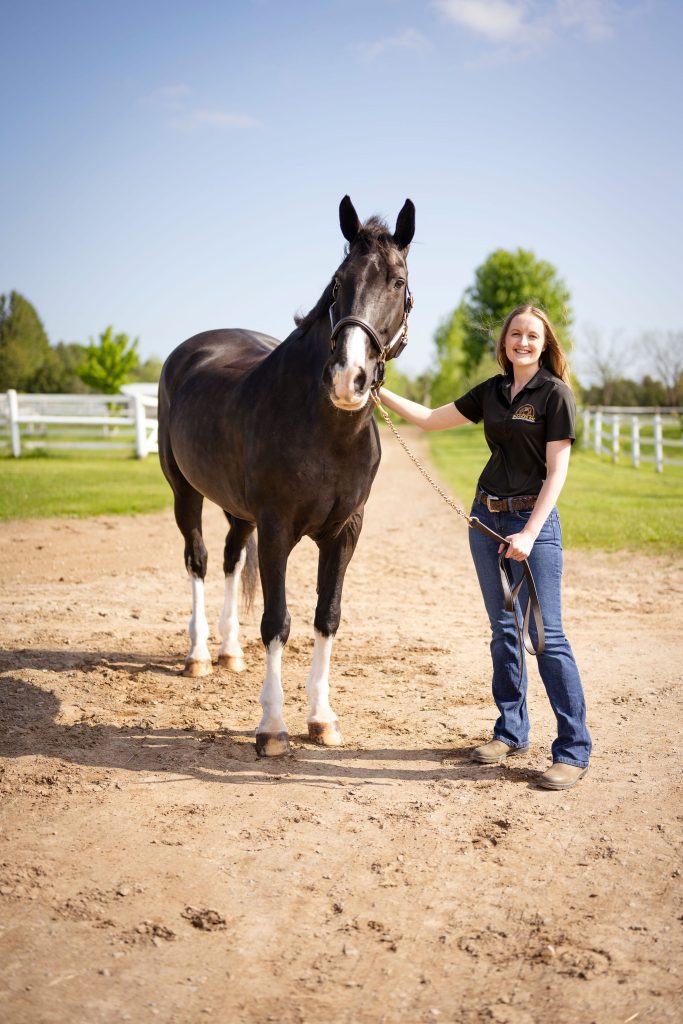
Equine obesity is a serious welfare issue for many horses. Research has estimated that depending on geographical region, about 30-50% of the domestic equine population is obese. These horses that tend to gain weight readily are often termed ‘easy keepers’, but in my experience, they can be some of the most difficult to manage.
As a nutritionist who works with many easy keepers and has my own – I can confidently say that no two weight loss plans are the exact same. Management constraints are a reality, so we must get creative in reducing caloric intake, while remaining conscious that the horse has adequate forage, and ensuring the program is practical to implement.
Reducing concentrate intake, avoiding energy rich treats, being precise with hay intake, implementing slow feeding, and increasing exercise are many of the common changes that are implemented when designing a safe weight loss program. Another tactic that is less common, but useful, is adding straw to a ration. This can be done in replacement of some of the hay, or in addition to the horse’s daily hay allotment.
The goal of adding straw to a ration is to increase the horse’s chew time and eliminate any fasting periods. Note that caution must be taken when adding straw to the ration, and when doing so it is recommended to work with an equine nutritionist.
Testing Your Hay
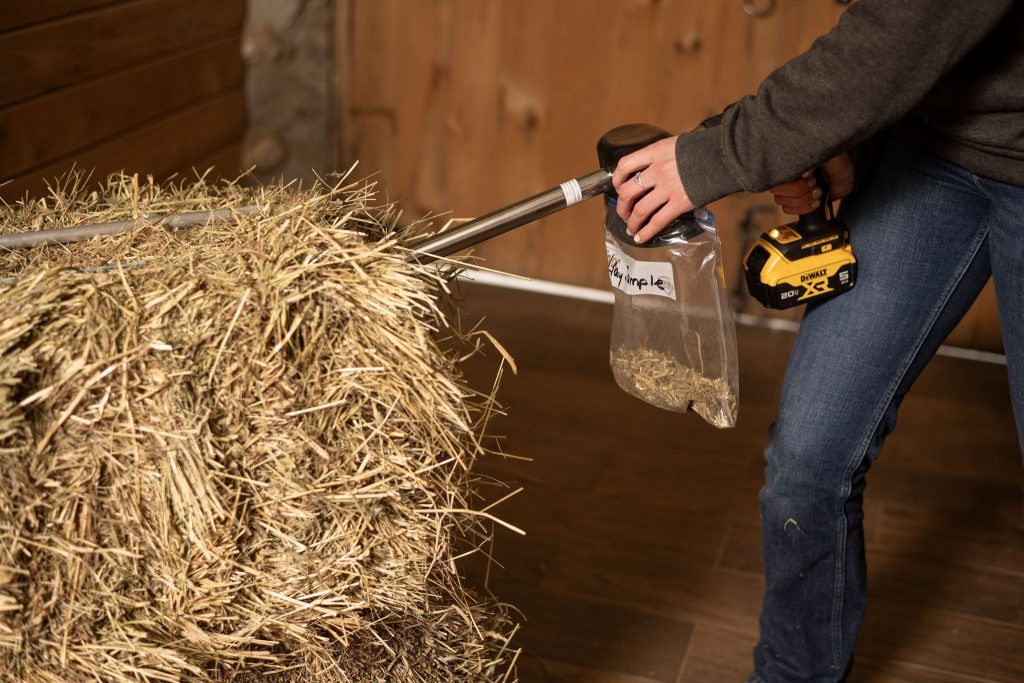
Before adding straw to your horse’s ration, the hay must be tested. By testing your hay, you are equipped with information on the nutritional quality. For easy keepers and horses with metabolic health issues, it is recommended to feed a ‘utility’ quality hay. This type of hay as a relative feed value (RFV) of 75-102, acid detergent fibre (ADF) ~41-45%, and neutral detergent fibre (NDF) ~47-53%. The RFV of hay is an indicator of digestibility, as this value decreases, so does the calorie content of the hay. For example, premium quality hay that would be ideal for a horse in very heavy work would have a RFV greater than 125.
If your hay quality is utility (grade 3 or 4), adding straw to the ration is not necessary as the calorie content of the forage you are feeding is already low. However, incorporating straw into a ration becomes extremely useful when the hay has a relative feed value greater than ~105. When we have a horse with very low-calorie requirements, that is on rich hay, it can be challenging to reduce their hay intake to a point that will elicit weight loss without compromising their well-being and gastrointestinal health.
If your hay is too rich for your easy keeper, where feeding 1.5% of their body weight daily is not preventing weight gain, or causing weight loss, then a lower nutritional value forage such as straw should be incorporated.
Types of Straw
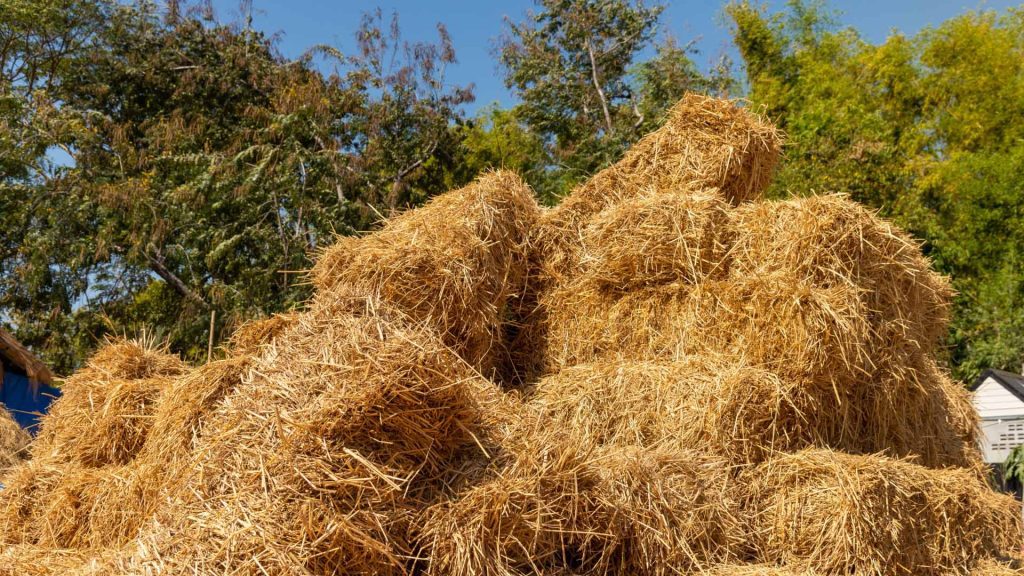
Barley, oat, and wheat straw are all options to be a partial hay replacement for horses. All three can be used, however, horses tend to find barley or oat straw more palatable than wheat straw as they are softer in texture. Additionally, when purchasing straw, it is important that it is clean (free of mold and debris), and free of any intact seed heads.
It is recommended to consider adding straw to your horse’s ration in the following situations:
Like hay, the nutritional content of straw will vary depending on numerous factors. Equi-Analytical Laboratory Services offers a free feed composition library that can be used as a tool to compare averages for various feeds and forages. Based on this database for the years 2004-2025, the average RFV of straw is 66.9. Remember that when RFV is lower, the forage is lower in digestible energy (calories). Gold standard is to test your straw prior to feeding, just as you would with hay.
What does the science say?
A 2024 study investigating the impact on consumption rate and chewing rate for horses fed either a 100% haylage ration, or a 50% haylage and 50% oat straw ration, illustrated that incorporating oat straw slowed consumption and altered chewing behaviour in favour of managing obese horses.
Another study investigated the feasibility of feeding a ration of 50% barley straw, and 50% hay to ponies compared with a ration of 100% hay. The authors concluded that straw was a cost-effective and low-energy roughage that can be used as an alternative to hay when trying to induce weight loss in equids. It was noted that there were no episodes of colic during the 4-month study period.
The inclusion in these studies is greater than what is generally required to elicit weight loss in practice but provides valuable insight into the safety of straw inclusion.
Practical Implementation
As with any change to an equids’ management, it should be done slowly. When introducing straw, start with replacing 10% of the horse’s daily hay ration with straw. Monitor for 14 days prior to making additional changes.
Although research has demonstrated that up to 50% of a horse’s hay ration can be safely replaced with straw, in practice, I have found that replacing 10-25% of the hay with straw tends to be enough to result in a calorie deficit. Of course, this depends on the individual equid, and the quality of the hay.
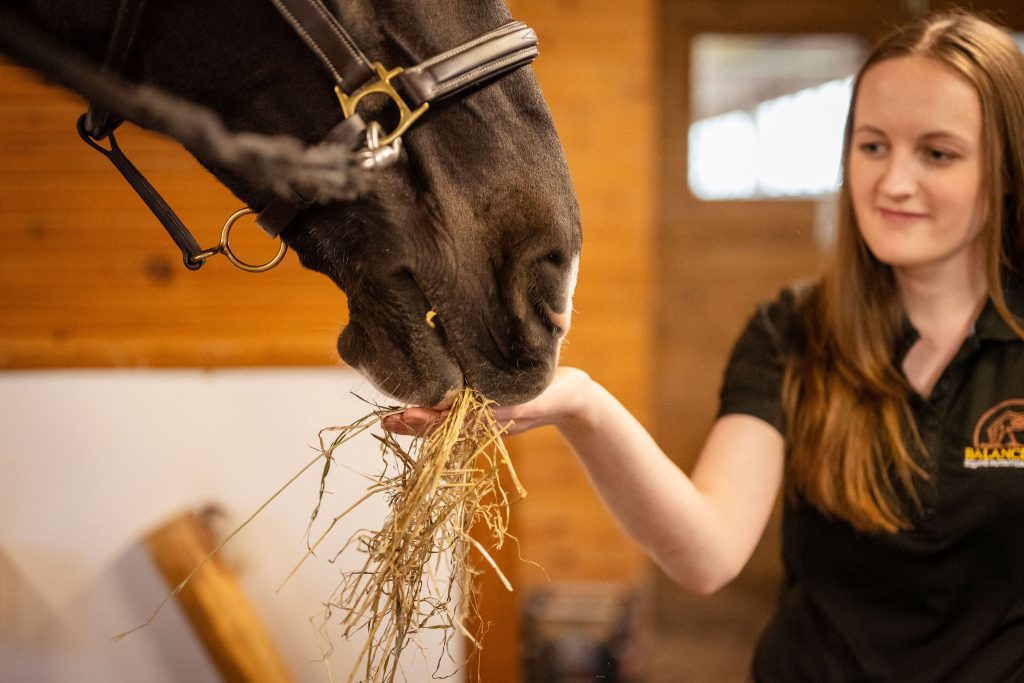
If your horse is being fed at least 1.5% of their body weight in hay and they are either losing weight, or maintaining a health body condition, but are having prolonged fasting periods, straw can be added to increase chew time. Again, introduce slowly over the course of 7-14 days. Most of the time, when straw is added, I recommend combining it with the hay in a slow feeder.
Safety Considerations
As straw is extremely fibrous, it should not be fed to horses with compromised dentition as they will not be able to adequately chew it. Additionally, when feeding a very fibrous ration that incorporates straw, extra care should be taken to ensure the ration is balanced and is providing adequate salt to encourage hydration as impaction colic is a risk if implemented improperly. Note that free choice access to a salt lick is not adequate. For an average sized horse, about 1-2 tbsp of loose salt is recommended daily.
Take Home Message
Easy keepers can be challenging to manage and creating a practical nutrition program that does not compromise the horse’s need for forage, friends, and freedom is critical to their welfare. If you have a challenging easy keeper, consider adding straw to their ration as a management tactic to reduce calorie intake. Note that it is strongly recommended to work with a qualified equine nutritionist for these cases.
If you have questions about your individual horse, please reach out at balancedbaynutrition@gmail.com.
By: Madeline Boast, MSc. Equine Nutrition, PAS
References:
Mostert, N., Witherow, B., & Williams, K. (2024). A preliminary study on feeding straw to horses and its effects on equine chewing and consumption rates.
Dosi, M. C. M., Kirton, R., Hallsworth, S., Keen, J. A., & Morgan, R. A. (2020). Inducing weight loss in native ponies: is straw a viable alternative to hay?. Veterinary Record, 187(8), e60-e60.