Horses require a minimum of 1.5-2% of their body weight in forage daily. Considering the horse’s weight, body condition score, and of course, forage quality are critical considerations when managing forage intake.
Optimal nutritional management is about more than providing adequate nutrients for weight maintenance and prevention of deficiency symptoms. We also must consider feeding management that supports the horse’s mental well-being and gastrointestinal health. As an independent equine nutritionist, I not only focus on what should be fed, but how it is fed.
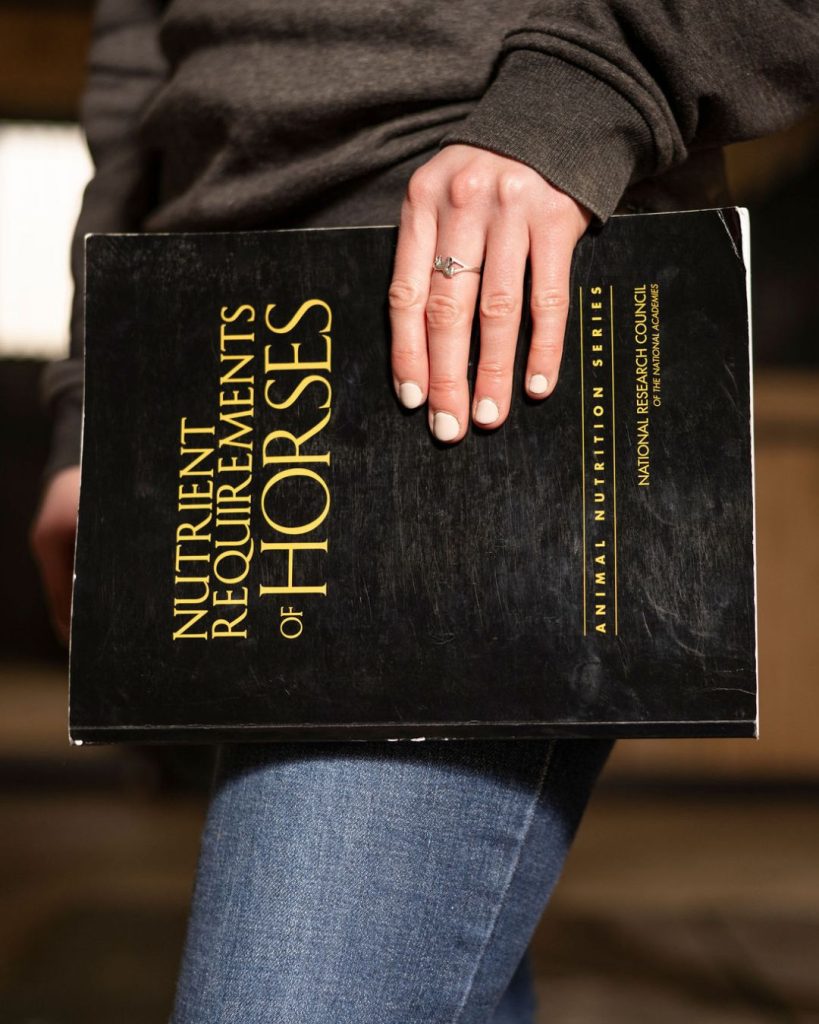
Horses are grazing animals – which means that forage is the primary component of their diet, often either hay or pasture. For anyone managing a horse’s nutrition, it is recommended to start with understanding their nutritional requirements and evaluating how the forage meets.
Depending on the quality of the forage, and the nutritional requirements of the horse, forage along might meet the horse’s protein and digestible energy requirements. However, note that all horses will need to be supplemented with vitamins and minerals that fill the nutritional gaps in forages.
The daily required intake of forage of depends on body weight. General recommendations are that horses should consume about 1.5-2.5% of their body weight in forage daily on a dry matter basis. To determine your horse’s body weight, it is best practice to use a livestock scale, however, in most situations this is not practical. Instead, we rely on mathematical equations to calculate an estimated body weight.
The following equation can be used to calculate weight of mature horses:
Weight (kg) = (Heart girth measurement in cm2 x body length measurement in cm) / 11,900
Once you have calculated your horse’s body weight, determine what 2% of that number is for your basic forage intake.
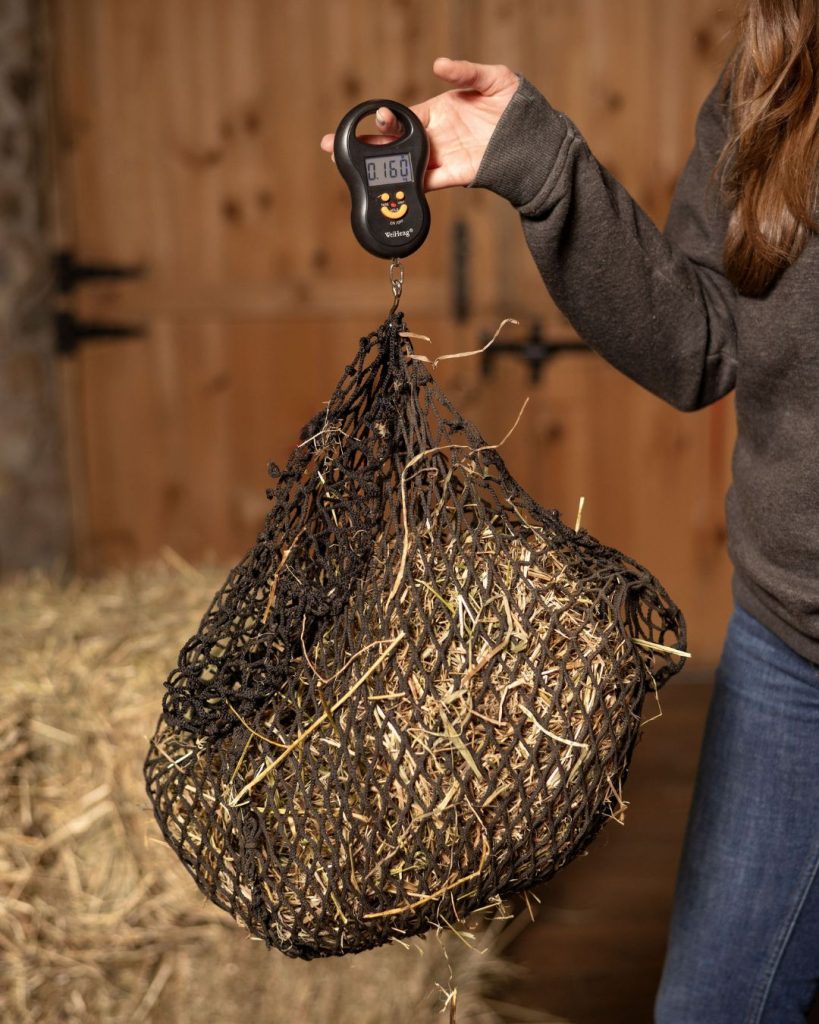
For many horses the number of flakes is relied on for feeding management. It is recommended to quantify the average weight of a flake of your horse’s hay using a hanging scale (fish or luggage scales work well!). This will allow you to determine if you are feeding an adequate amount to support gastrointestinal health.
When managing horses on a round bale, you can use a hay net or large bucket to weigh hay amounts if the horse is being fed a set amount. If the horse has continual access to the round bale, it is considered free choice access.
Next, understanding the distinction between dry matter and as-fed intake is important for accuracy when discussing hay amounts. Dry matter refers to the forage after the moisture has been removed, while as-fed is the forage in its natural state, which includes the moisture content. The moisture content of hay is low, generally ~6-15%, so the amount weighed out, might be slightly higher than 2% of the horse’s body weight to account for the moisture weight.
For example, if you have a 500 kg (1100 lb) horse, and they are consuming hay that is 90% dry matter, their as-fed intake should be 11 kg of hay daily. On the other hand, pasture is much higher in moisture content (normally ~80% moisture, which is 20% dry matter). The same 500 kg horse would then be consuming about 50 kg of pasture on an as fed basis.
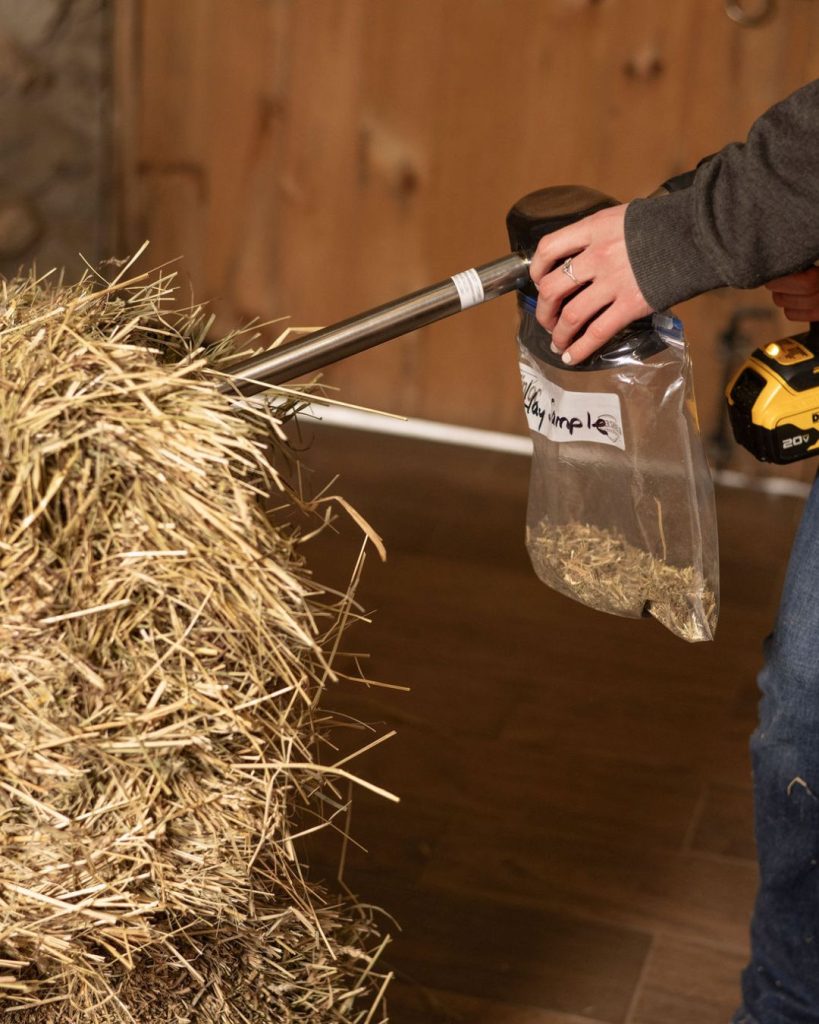
I like to emphasize this concept when horses are housed on over-grazed pasture without access to hay. As even though the field might look green, most horses will struggle to meet their fibre intake requirements and hay should be supplemented in combination with the pasture access.
Whenever forage intake is discussed, the quality of that forage must also be considered. For ease of management, digestive health, and mental well-being, it is preferable to allow horses to have free choice access to forage. However, horses might overconsume free choice hay or consume 2% of their body weight in hay too rich for their calorie requirements.
You cannot feed a very easy keeper hay that is too rich, it simply will not work. For example, if 1% of the horse’s body weight in hay meets their calorie requirements, it is not enough roughage intake to support digestive health and their natural foraging behaviour.
These cases of increased calorie consumption can contribute to weight gain or obesity, a serious and prevalent welfare issue. This is when how the forage is fed becomes critical with implementation of management tools such as track systems, slow feeders, and grazing muzzles.
On the other hand, hard working horses, and those with elevated calorie requirements (e.g., lactating broodmare), will not do well on hay that is poor quality as they will struggle to consume enough to meet their calorie requirements. This generally results in horses that are underweight, despite being fed large amounts of concentrates.
This weekend, try to quantify your horse’s weight and their current hay intake. Consider if they are at a healthy weight, overweight, or underweight. Should their forage intake be increased or decreased? Next, consider making a plan to have your new hay tested once it is harvested. Let’s have confidence in our horse’s forage management!
If you’d like to work together to optimize your horse’s forage intake please reach out to Madeline, or choose a nutrition consultation program.
If you have questions about your horse’s forage management, please reach out at balancedbaynutrition@gmail.com
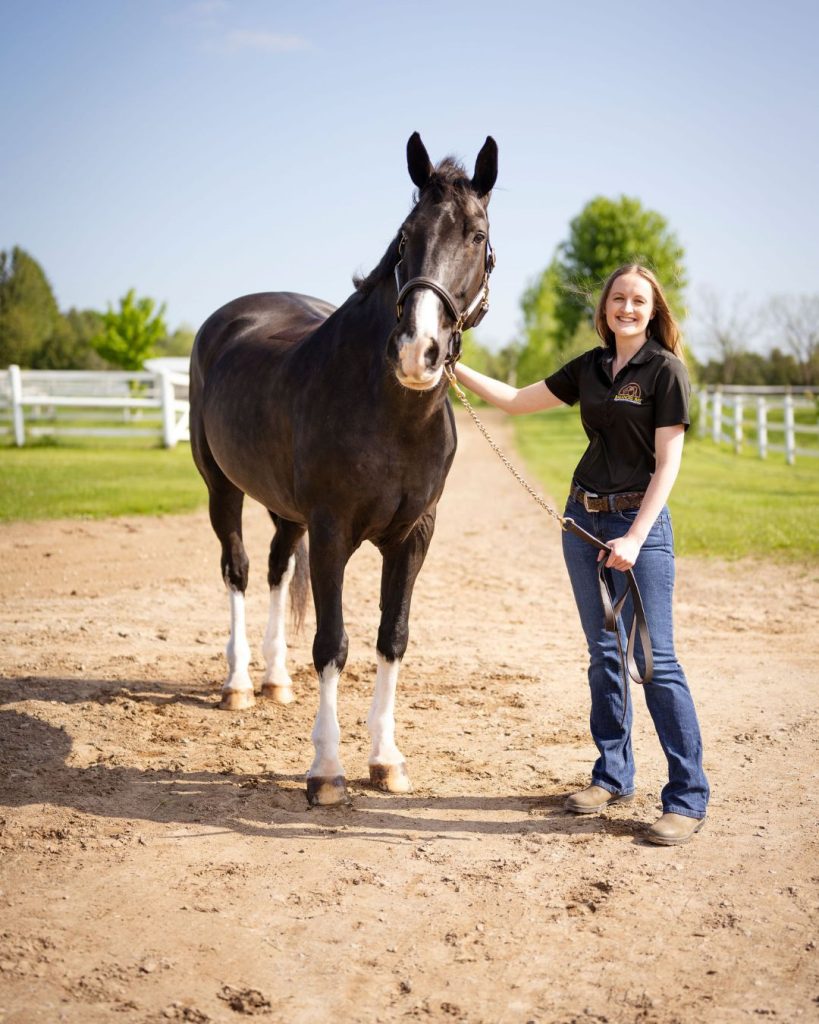
By: Madeline Boast, MSc. Equine Nutrition, PAS
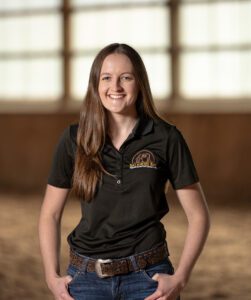
Madeline is an independent equine nutritionist and the founder of Balanced Bay. She holds a bachelor's degree in Equine Management and a master's degree in Equine Nutrition, both from the University of Guelph, along with a Professional Animal Scientist (PAS) designation, a hay sampling certification, and additional training in equine body condition scoring. Her graduate research focused on equine obesity and metabolic issues. Madeline works with horses of all types — from companion ponies to competitive sport horses — designing science-backed, forage-first nutrition plans with no brand affiliations or sales commissions involved.
Madeline is an independent equine nutritionist and the founder of Balanced Bay. She holds a bachelor's degree in Equine Management and a master's degree in Equine Nutrition, both from the University of Guelph, along with a Professional Animal Scientist (PAS) designation, a hay sampling certification, and additional training in equine body condition scoring. Her graduate research focused on equine obesity and metabolic issues. Madeline works with horses of all types — from companion ponies to competitive sport horses — designing science-backed, forage-first nutrition plans with no brand affiliations or sales commissions involved.